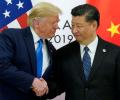
"We are capable of properly resolving the issues between us through dialogue and consultation. We do not need the intervention of the third party", he said.
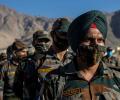
The Indian side also told the Chinese delegation that the talks on disengagement should include Depsang as well as all face-off sites, insisting that it should be a simultaneous process and not a selective one.

China on Saturday summoned the United States Charge d'Affaires in Beijing and lodged a strong diplomatic protest over the meeting between President Barack Obama and Tibetan spiritual leader Dalai Lama.
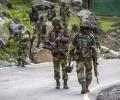
The sources said there was clear sign of withdrawal of structures and troops from the patrolling point 14 in Galwan Valley and that they are likely to move back more than a kilometre in the area.

The sources also said another round of military talks between the two sides on Wednesday to defuse tensions in the area remained inconclusive. The talks lasted nearly seven hours.
The decisions were mentioned in a joint statement issued by the two armies late Tuesday, a day after the sixth round of Sino-India Corps commander-level talks that lasted for 14-hours.

This is the first time such a bilateral dialogue focusing on Central Asia where the two countries have long and historical ties was held, reflecting deepening diplomatic engagement between the two neighbours even as they try to sort out friction resulting from recent reported incursions by Chinese troops along the Ladakh border
Even senior Indian officials have openly stated that Chinese troops did not enter into the Indian territory, Wang said.

'From the very start, PM Modi was insistent that visiting foreign leaders should be exposed to an India beyond its capital.' 'Through these experiences, he felt that the full Indian narrative would be much better understood across the world,' explains External Affairs Minister S Jaishankar. A riveting excerpt from Bluekraft Digital Foundation's Modi@20: Dreams Meet Delivery.
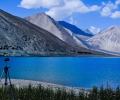
China said that for a long time China has been conducting activities on its side of the Line of Actual Control and they have always complied with relevant agreements.
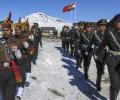
The decision to disengage the forces, locked in a bitter standoff for the last six weeks in eastern Ladakh, was taken at a nearly 11-hour-long meeting between senior Indian and Chinese commanders in Moldo on the Chinese side of the Line of Actual Control (LAC) on Monday.
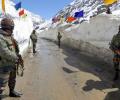
The clear assertion by New Delhi came ahead of a fresh round of Lt General-level talks between the Indian army and the Chinese PLA which government sources said is set to take place within the next two days.

The Congress alleged that whenever an issue of national security comes up, the "prime minister hides behind his ministers".
Rejecting New Delhi's assertions that Beijing should respect India's sensitivities on Kashmir, China on Tuesday said that its policy of issuing stapled visas to Kashmiris would remain unchanged, in crucial comments ahead of a meeting between prime ministers of the two countries.

'(The) PM has surrendered Indian territory to Chinese aggression. If the land was Chinese: Why were our soldiers killed? Where were they killed,' he asked on Twitter, tagging the prime minister's remark.
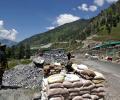
India's top military and strategic brass on Tuesday reviewed the overall situation in eastern Ladakh amid indications that the latest round of talks between senior military commanders of Indian and Chinese armies on the next phase of disengagement of troops may not have produced encouraging results, people familiar with the developments said.

China said that it had put off the visit of Indian pilgrims who enter Tibet via the Nathu La pass "for safety reasons" in view of the border issue.

All the evacuees will undergo a 14-day quarantine at a medical facility.

'Why wouldn't so strategically-minded an adversary, such as China, not militarily exploit to the maximum Indian timidity, stupidity, and cupidity all along the LAC and legitimate, as it has done so often in the past, the fait accompli of incremental territorial grabs which, by the way, is its strategy and policy as implemented on the ground?'
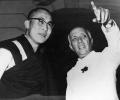
One priority for Delhi (for the new foreign secretary in particular) is to have an in-depth discussion with Dharamsala as soon as possible, suggests Claude Arpi.
External Affairs Minister Pranab Mukherjee will embark on a visit to China from June 4 which Beijing hopes would promote "mutual political trust" and deepen "practical cooperation" between the two neighbours. Mukherjee would hold talks with his Chinese counterpart Yang Jiechi on better implementing the consensus on developing the partnership of strategic cooperation.
The Summit will take bilateral relations to a higher level and have a major and positive impact on regional and world peace, stability and development, Sun said.

The inter-ministerial committee will coordinate investigation against Rajiv Gandhi Foundation, Rajiv Gandhi Charitable Trust and Indira Gandhi Memorial Trust.
The passengers included 10 foreigners, according to the state-run Nepal Television.
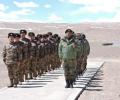
The sources said the ongoing engagement and dialogue at military and diplomatic levels have resulted in complete disengagement of troops at patrolling point 14, 15 and 17 A in eastern Ladakh.

'India has ramped up infrastructure on its side, so the Chinese military is finding Indian soldiers in locations where they are not used to seeing an Indian footprint,' points out Harsh V Pant.
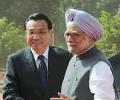
China on Tuesday said Li Keqiang's visit to India would give a strong boost to bilateral strategic cooperative partnership even as the premier himself termed his trip as "successful" and "felt at home" during talks with his counterpart Manmohan Singh.

'Xi Jinping is keen that the second Trump-Kim summit happens soonest.' 'Kim is reported to have told Xi that he expects to achieve a result from a second summit that the international community would welcome,' points out Dr Rajaram Panda.

China on Wednesday said it attaches 'great importance' to Sushma Swaraj's visit to Beijing.

Welcoming Jaishankar, Foreign Minister Wang referred to the Indo-Pak tensions without directly mentioning about India scrapping the Article 370 of the Constitution that gave special status to Jammu and Kashmir.
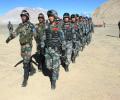
The two countries reviewed the situation in the region during a fresh round of online diplomatic talks under the framework of the Working Mechanism for Consultation and Coordination (WMCC) on border affairs.

The formal process of disengagement of troops began on July 6, a day after a nearly two-hour telephonic conversation between National Security Advisor Ajit Doval and Chinese Foreign Minister Wang Yi on ways to bring down tensions in the area.

The world's attention is on the new Taliban and the imminent announcement of an inclusive government in Kabul, observes Ambassador M K Bhadrakumar
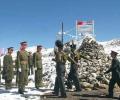
At the talks, the Indian side insisted on complete disengagement of Chinese troops at the earliest and immediate restoration of status quo ante in all areas of eastern Ladakh prior to May 5 when the standoff began following a clash between the two armies in Pangong Tso, they said.
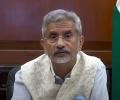
In his brief address, the external affairs minister said India's friendship with Afghanistan is "strong and unshaken" and that no part of the country is untouched by New Delhi's development programmes.

China on Thursday congratulated the new Pope but set conditions for normalisation of ties with the Vatican, saying the Holy See should severe ties with Taiwan and stop interfering in its internal affairs in the name of religion.
Setting stiff conditions for improving ties with the Vatican, China on Monday said the new pope should sever links with Taiwan and stop interfering in its internal affairs in the name of religion.

Mahindra and Mahindra was the top gainer in the Sensex pack, advancing over 7 per cent, followed by Bajaj Finance, Reliance Industries, Maruti, TCS, HDFC Bank and Tata Steel. On the other hand, Bajaj Auto, HDFC, Bharti Airtel and HUL were among the laggards.

'During his visit to Vietnam on September 3 -- the first visit by an Indian prime minister in 15 years -- Modi will notice the widespread anti-China sentiment in that country.'
Taking serious note of protests by Tibetans in India during the visit of President Hu Jintao, China on Thursday said Tibet was an "integral part" of its territory and the region's affairs were an "internal matter".
